 Lexie


 App of the Day
from the creators of
 murmur
 Layered
How it is built
The passé composé has two parts: a present-tense form of avoir, then the past participle. For example, j'ai parlé means I spoke or I have spoken.
All four verbs here take avoir. A smaller group of verbs, aller among them, takes être, and Lexie leaves those out of this tense.
The four participles
| Verb | Participle | With je |
|---|---|---|
| être | été | j'ai été |
| avoir | eu | j'ai eu |
| faire | fait | j'ai fait |
| parler | parlé | j'ai parlé |
Every form
| être | avoir | faire | parler |
|---|---|---|---|
| j'ai été | j'ai eu | j'ai fait | j'ai parlé |
| tu as été | tu as eu | tu as fait | tu as parlé |
| il a été | il a eu | il a fait | il a parlé |
| nous avons été | nous avons eu | nous avons fait | nous avons parlé |
| vous avez été | vous avez eu | vous avez fait | vous avez parlé |
| ils ont été | ils ont eu | ils ont fait | ils ont parlé |
How to drill it
- Say the avoir forms on their own first: j'ai, tu as, il a, nous avons, vous avez, ils ont.
- Add one participle and run all six persons.
- Then switch verbs without changing the person: j'ai été, j'ai eu, j'ai fait, j'ai parlé.
In the app
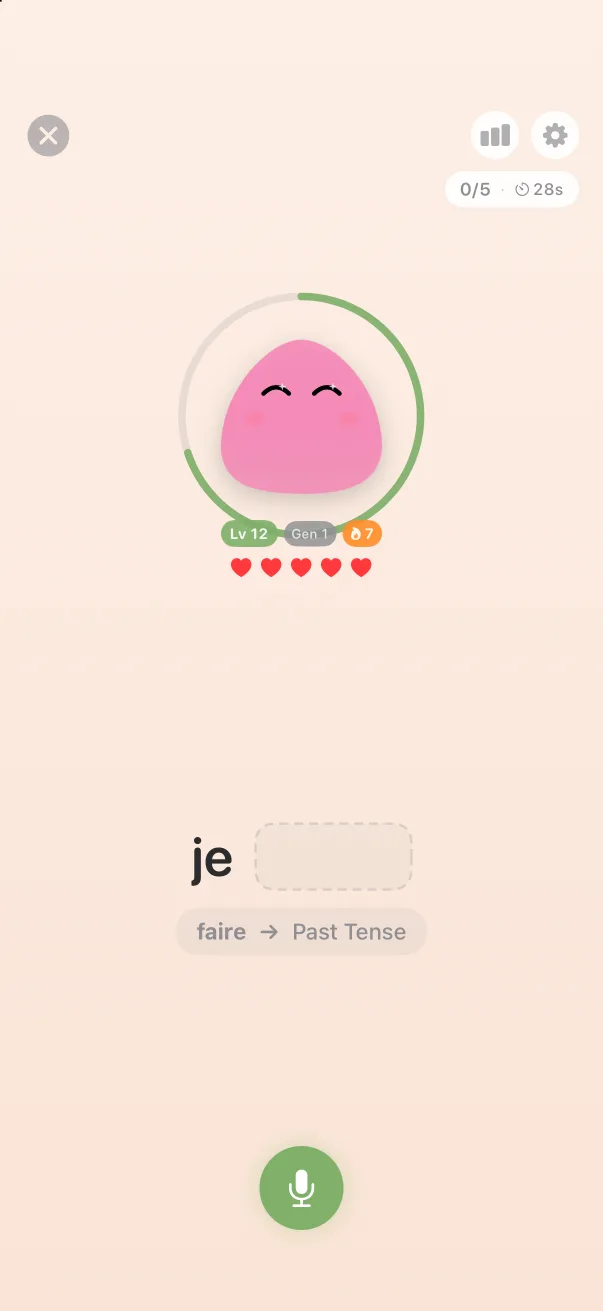
A round in Lexie gives you a pronoun, a verb and the tense, for example je, faire, Past Tense. You tap the form or say it out loud.
Published 11 November 2026. The number and verb forms on this page are exported from Lexie itself.
 80 in French
 Danish numbers
 French 70 to 100 by ear
 Memorise conjugations
 French homework routine