 Lexie


 App of the Day
from the creators of
 murmur
 Layered
The short answer
| Number | France | Belgium | Switzerland |
|---|---|---|---|
| 70 | soixante-dix | septante | septante |
| 80 | quatre-vingts | quatre-vingts | huitante or quatre-vingts |
| 90 | quatre-vingt-dix | nonante | nonante |
Why France counts in twenties
In the Middle Ages people in France counted in twenties. Forty was deux vins and sixty was trois vins. From the end of the Middle Ages the shorter words trente, quarante, cinquante and soixante took over, and stopped at sixty. The Académie française says no explanation for that is fully convincing.
In the 17th century the Académie and the other dictionary makers settled on soixante-dix, quatre-vingts and quatre-vingt-dix. Septante, octante and nonante have stayed in every edition of its dictionary.
What you will hear where
Septante and nonante are official in Belgium and Switzerland. Octante has dropped out of use: Belgium says quatre-vingts, and Switzerland says quatre-vingts or huitante. The older words are also still known in parts of eastern and southern France and in Acadia.
Which one to learn
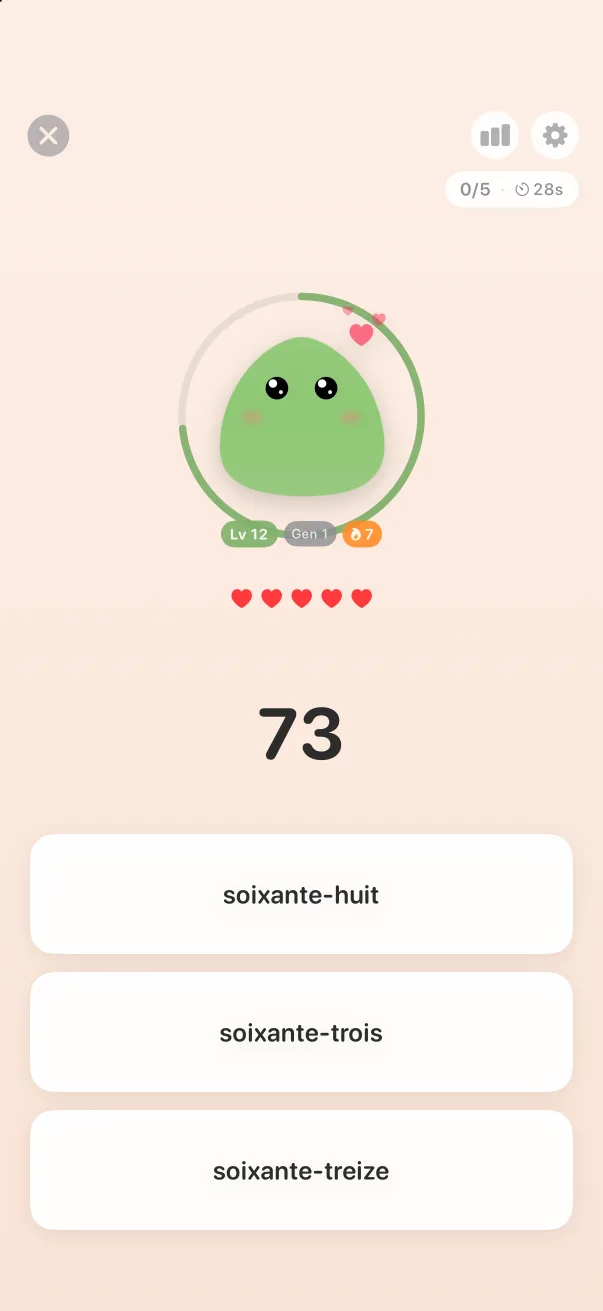
Learn the forms of the place you are going. Lexie teaches the ones used in France, because they are the hard ones: 97 is quatre-vingt-dix-sept, four-twenty-seventeen. Septante and nonante follow the decimal pattern, like trente and quarante.
Source: Académie française, Questions de langue, "Septante, octante, nonante", read on 11 November 2026.
Published 11 November 2026. The number and verb forms on this page are exported from Lexie itself.
 Danish numbers
 French 70 to 100 by ear
 Passé composé practice
 Memorise conjugations
 French homework routine